Before you can begin implementing DigipassONE Verify, you should first become familiar with the following key terms and concepts.
Digital credentials
A digital credential is an electronic attestation of attributes—such as identity, qualifications, or entitlements—issued by a trusted authority and held by an individual, typically in a digital wallet.
It can often be selectively disclosed and cryptographically verified by relying parties, without needing to contact the issuer directly. Examples include:
Mobile driver's licenses
W3C Verifiable Credentials
Digital diplomas
EU Digital Identity Wallet attestations
Each credential follows its own technical standards, but shares the same core purpose: enabling trustworthy, portable digital proof of information about a person.
The credential lifecycle
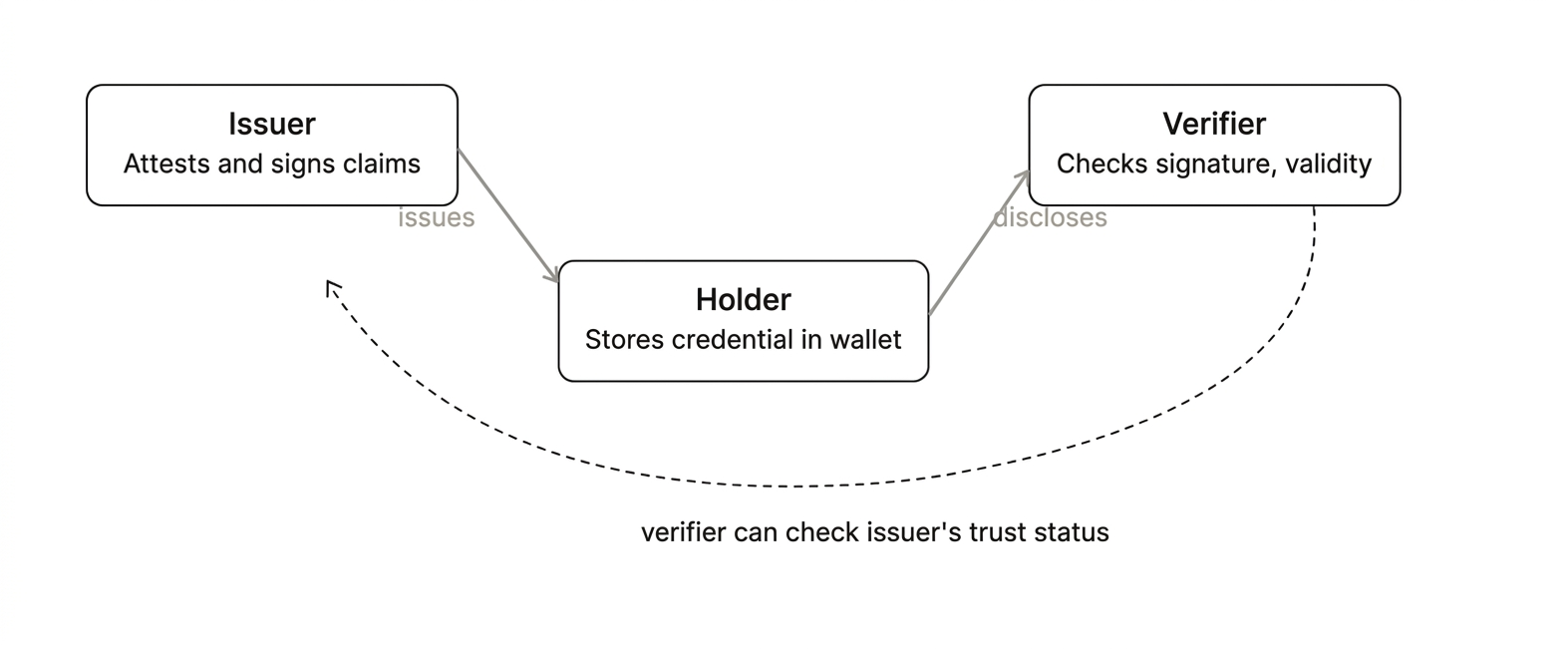
Every digital credential moves through three roles:
An issuer attests facts and signs them
A holder stores them in a wallet, and
A verifier (relying party) checks them on request.
Issuance
An issuer authenticates the person, packages the attested attributes into a credential, verifies the wallet attestation, and delivers the credential to the wallet using a defined protocol (commonly OpenID4VCI).
The wallet checks the issuer's identity against a trust registry before accepting it — this is what later enables a verifier to trust the credential without contacting the issuer directly.
Credential format: SD-JWT
Most wallet credentials use SD-JWT (Selective Disclosure JWT), sometimes as SD-JWT VC. The issuer:
hashes and salts each individual claim
signs the set, and
gives the holder the full bundle.
When presenting, the holder reveals only the disclosures a verifier actually needs — the verifier can confirm each revealed claim matches a hash in the signed structure, without ever seeing the hidden ones. This is what makes selective disclosure possible: proving your date of birth without exposing your address.
Verification and presentation
A verifier requests specific claims (often via OpenID4VP), the wallet prompts the holder to approve disclosure, and the verifier checks the issuer's signature, expiry, and revocation status.
This step confirms the data is authentic and unaltered.
Holder authentication
Holder authentication (or holder binding) proves that the person presenting the credential is the one it was originally issued to, i.e., the credential holder and the credential subject are the same.
This is typically done through a device-bound private key, unlocked by a PIN, biometric, or similar factor, which the wallet uses to prove possession during a presentation.
It is distinct from credential verification, which only confirms the attributes themselves are genuine and untampered — a credential can pass that check while still failing holder-binding, for example if it is presented by someone other than its rightful holder.